The Department of Missouri planned and celebrated the 75th Anniversary of ROA’s Congressional Charter being signed by President Harry Truman at the Harry S. Truman Library & Museum in Independence, Missouri on June 30.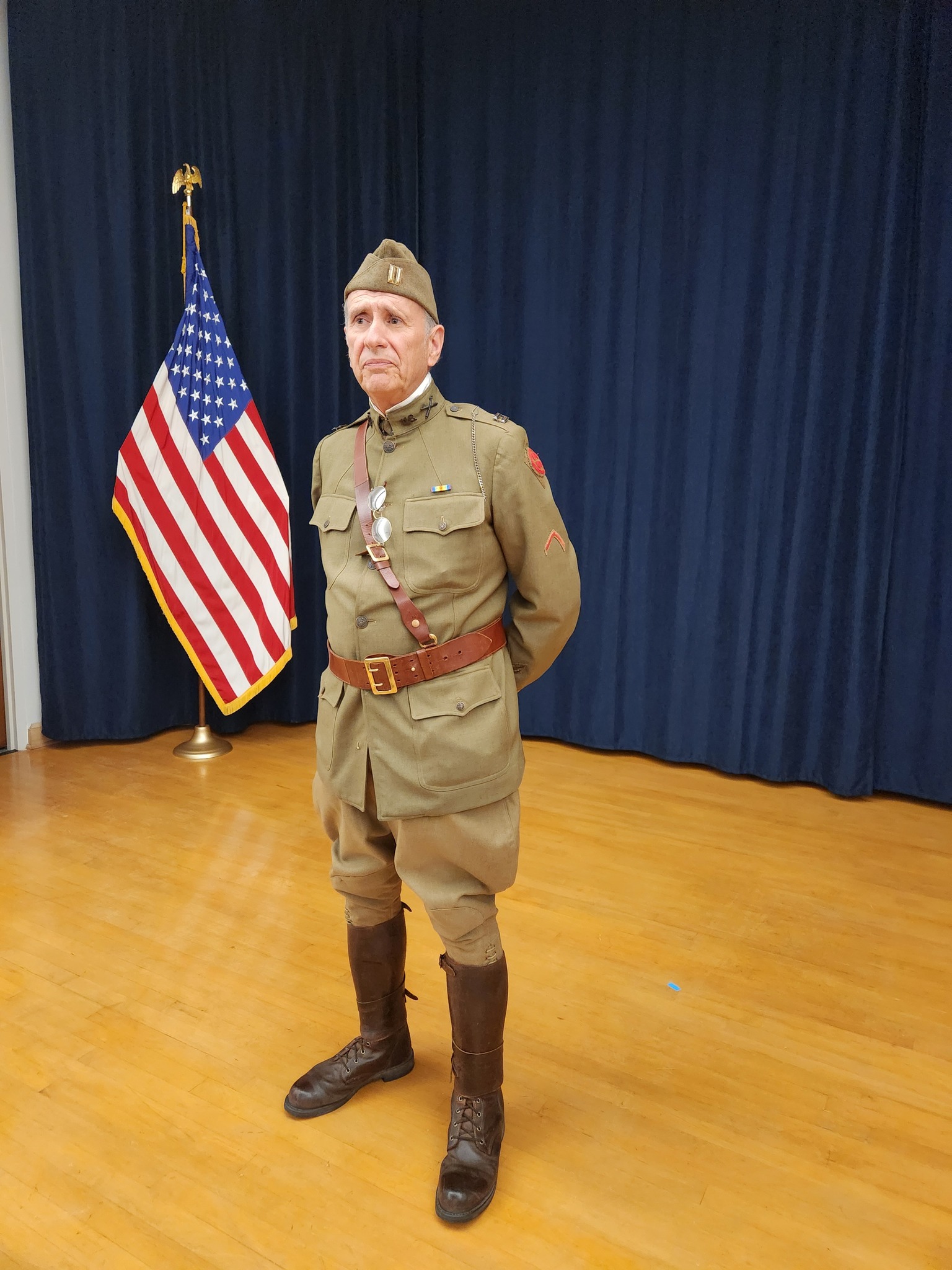
Six members of the Department of Missouri - including a surprise appearance by "Captain Truman" himself, attended.
On hand from the Department of Missouri were Chief Warrant Officer 4 John Travers (Harry S. Truman Chapter 1), Lt. Col. Kathleen Conley, Cmdr. Ellen Duvall and Maj. Kavan Stull (Springfield Chapter 28), Lt. Col. Bob Dietrich (St. Louis Chapter 30), and Col. Bob Shankel (Whiteman Chapter 442). Lt. Col Richard Stephens, Jr., represented the Department of the Southeast.
Library staff handed out an ROA trifold to museum guests that described Truman’s military service and support of the ROA and Reservists. A large copy of the charter was displayed on an easel. Travers said, “We’re here to celebrate the 75th Anniversary of the signing of the charter and tell attendees at the library how important President Truman was to our existence.”
Duvall added, “President Truman knew how important Reservists were to America’s strength and defense. Our charter is a result of his support.” It was signed on June 30, 1950.
"Captain Truman," in a historically accurate WWI uniform (103-year-old French trousers and tunic), suddenly appeared to surprised attendees on the auditorium’s stage at 11 a.m. and 1:30 p.m. to explain his role in the U.S. Army before, during and after WWI.
The actor playing Truman's younger self was actually Maj. Kavan Stull, a historical interpreter with the Springfield Chapter. Stull captivated 70 people during two, 45-minute presentations. Stull used humor and anecdotes between historically accurate stories that were based on letters between Bess, Truman's wife, and himself.
He opened the monologue as if writing a letter to Bess. “I hope you still recognize me and I hope you still love me because of this peacetime Army and lots of beans, I’ve managed to gain a lot of weight. I now have a double chin and my uniform fits like skin on a sausage.”
The audience learned how Truman’s 194-man Battery D trained at Fort Sill and in France, shot their first artillery shells against the Germans on Aug. 29, 1918, and supported several Allied offensives, such as the Meuse-Argonne offensive. The remainder of the talk related his post-war experience in Army Reserve units and how he got into politics.
"Truman" ended his talk with an anecdote: “There’s three things in life that can ruin a man: power, money and women. You know, I didn’t seek power… As for money, you show me a politician who makes money while he’s in office, and I’ll show you a crook. As for women, Bess says I gotta be home about 12, so I guess I better get going.”
He left the stage with generous applause. Roger Poteet, a volunteer at the museum, said, “He did a wonderful job in the way he presented Truman’s history.” Asked what prompted Stull to start his historical interpretations, he said, “I’ve always had a fascination for him (Truman). And I read the book he wrote called, ‘Letters to Bess.’ In that book, he outlines his story of WWI. He told Bess just about everything he did ... I thought it was a story that just needed to be told.”
Skull has delivered 25 or 30 presentations for three-and-a-half years, mostly at historical society meetings. Afterwards, Travers reiterated his respect of President Truman because Truman founded the Reserve Officers Club in Kansas City in 1921, was president of the Harry S. Truman Chapter and big supporter of Reservists and Guardsmen.
Because of President Truman’s support, Travers said, “I think it (ROA) did grow in influence with Congress… It is one of the few military organizations that has a charter from Congress to represent the military people. A lot of the benefits we have today is from the Reserve Officers Association being an advocate.”
The ROA trifold was written by Richard Stephens and designed by Kalen Cotto, U.S. Army Reserve veteran, president of KMC Digital, and ROA contractor.
The charter’s 75th Anniversary provided another fantastic opportunity to tell ROA’s story to the public.
 Blog Home
 All Blogs

 RSS
RSS