Posted By Reserve Organization of America,
Friday, December 1, 2023
With yet another fatal crash of the military’s V-22 Osprey aircraft, the Reserve Organization of America wrote Secretary of Defense Lloyd J. Austin on Nov. 29 calling for the immediate grounding of the Osprey.
The letter was sent in direct response to the fatal crash of the aircraft in Japan on Nov. 29. This disaster, which has claimed at least one life, is the second fatal Osprey crash in four months.
In August, just one year after the Air Force cleared its grounding of Ospreys amid unresolved clutch problems, a Marine Corps Osprey crashed, killing three.
“Mounting evidence suggests that the V-22 Osprey is seriously flawed,” said ROA’s executive director, retired Army Maj. Gen. Jeffrey E. Phillips. He wrote, “The Osprey was first flight tested 34 years ago and fielded to the military 15 years ago; by now it should work reliably. No other U.S. military aircraft exhibits the Osprey’s fatal propensities.”
Reports state that the Osprey which crashed Wednesday into the sea off Japan was an Air Force aircraft.
As of its crash, 16 V-22 Ospreys have been damaged beyond repair in accidents that have killed a total of 56 people. Four crashes killed a total of 30 people during testing from 1991 to 2000.
While some crashes have been attributed to pilot error, since the V-22 became operational in 2007, 12 crashes, including two in combat zones, and several other accidents and incidents have killed 26 people.
The V-22 Osprey is a combat aircraft with tiltrotor technology, which combines the vertical performance of a helicopter with the speed and range of a fixed-wing aircraft.
Various issues with the Osprey, however, can cause its uncontrollability with disastrous results. The Osprey in Wednesday’s fatal crash was reportedly inverted, with one of its engines on fire, before plunging into the sea.
Serving and former service members have expressed to ROA their reluctance to fly in the Osprey. One Marine Corps reservist said he decided not to pursue pilot training because he might be assigned to fly the Osprey. “If given a choice to fly in the V-22 Osprey, I would not,” a retired Navy commander wrote.
In ROA’s letter, Phillips wrote, “The evidence has mounted for more than a decade that, while the concept of tiltrotor “briefs well,” this example of the concept is simply not ready for prime time. For the time being, in its absence, other airlift assets would serve – must serve – in the Osprey’s place.”
“How many more young warriors will die and be injured,” Phillips wrote, “some horribly, before we admit the problem and do the right thing? How much more dread– and potentially grieving – will we force on families and comrades? Does the continued use of this aircraft enhance trust among families whose son or daughter may be considering service?”
“The men and women who designed and make the Osprey certainly take justifiable pride in their work for the nation. That is not the issue. If the Osprey is still risking lives because of a reluctance to face a hard reality, that is an issue.”
“The innovations underlying the Osprey’s advanced capabilities and the willingness and capacity of American industry to develop such a system are essential for modernization,” Phillips said. “Yet the development of military equipment comes at a cost, often a human cost. Sometimes the cost is too high, and we must take a step back for revaluation and, if possible, refinement. With the Osprey, now is that time.”
The appearance of U.S. Department of Defense (DoD) visual information does not imply or constitute DoD endorsement.
Posted By Corporate Gray,
Thursday, November 30, 2023
On Thursday, December 14 from 11 a.m. to 2 p.m. Eastern Time, there will be a Virtual Military-Friendly Job Fair to connect transitioning service members, veterans, and other members of the military community with employers nationwide.
The job fair flyer is attached. We would appreciate you sharing this information with those individuals in your organization who are seeking employment. Thanks in advance!
Posted By Brig. Gen. John Brown, U.S. Army retired,
Monday, November 27, 2023
The U.S. has defended itself with an all-volunteer force for 50 years. Relying on conscription during World War I and World War II and the early Cold War, Americans soured on the draft during the prolonged Vietnam War.
Running for president in 1968, Richard Nixon promised to end the draft and established the Gates Commission to assist in that purpose once elected. Congress allowed the draft law to expire in July 1973.
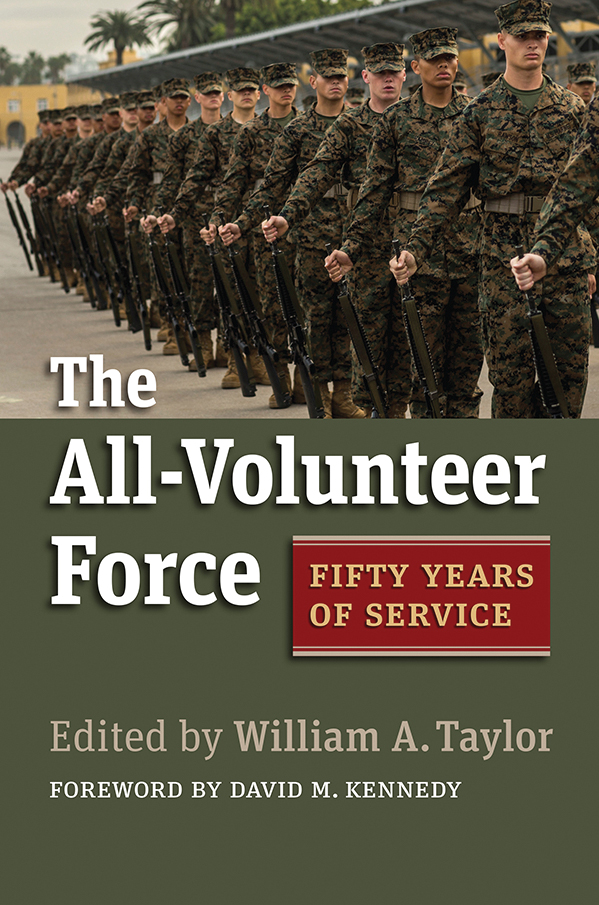
Recognizing this anniversary, William Taylor, author of Every Citizen a Soldier: The Campaign for Universal Military Training After World War II, has assembled this fine anthology, The All-Volunteer Force: Fifty Years of Service. Drawing on recognized experts, it addresses major facets of the all-volunteer force in four parts.
In Part One, “History,” Amy Rutenberg provides historical background. Then, Michael Gibbs and Timothy Perri underscore the role of economists in deciding upon an all-volunteer force. Taylor describes the deliberations of the Gates Commission, and Beth Bailey explores issues concerning race and diversity.
Shifting to Part Two, “Results,” Kara Dixon Vuic examines the roles of women. Jennifer Mittelstadt then describes the evolution of a “wrap-around welfare state” within the military as an incentive for retention and recruitment. Titus Firmin describes the all-volunteer force as firmly middle class, with the lowest socioeconomic quintile not qualifying for and the highest quintile not interested in military service.
In Part Three, “Challenges,” retired U.S. Army Reserve Maj. Gen. Dennis Laich ponders the long-term viability of the all-volunteer force, given a shrinking pool of eligible young people with smaller percentages inclined to military service. Lawrence Wilkerson opines that the all-volunteer force is too easy to use but not big enough to win major wars. Retired Maj. Gen. Jeffrey Phillips then discusses the force’s radically increased reliance on the reserve component.
“Implications” of the all-volunteer force include an emerging culture, explored by Adrian Lewis, wherein service is no longer an expectation of citizenship. Mark Cancian explores force structure, citing the reserve component, government civilians, capital assets and contractors as alternatives to regular forces. Marybeth Ulrich examines force demographics over time, discovering reasonable representativeness but a growing civil-military gap.
As is often the case with anthologies, transition from one essay to the next can be jarring. Taylor remediates this with a conclusion tying threads together and providing overarching commentary.
The all-volunteer force has enjoyed striking successes and faced troublesome challenges. Not ideal for all circumstances, it seems a best fit that will remain with us unless circumstances substantially change.
The essays are pithy, focused, informative and well documented. Almost 800 tightly written endnotes provide a treasure trove for those wanting to do more research. Taylor also provides a chronology and paragraph-length backgrounds of the contributing authors.
As excellent as this collection is, more attention to alliances and to the “standby draft” might improve it. Most strategic scenarios envision U.S. forces fighting alongside more numerous allies. This influences the size and composition of the all-volunteer force. If the force is too small for a big war, how would a resurrection of conscription work, and what are the plans for having one? Essays on these topics might render a future version of this volume even more comprehensive.
Taylor provides an invaluable service by gathering and publishing this outstanding volume. I strongly recommend it to anyone interested in the experience of our armed forces over the past 50 years. It provides a firm foundation to contemplate the evolution of these forces going forward.
Brig. Gen. John Brown, U.S. Army retired, served 33 years in the Army, with his last assignment as chief of military history at the U.S. Army Center of Military History. The author of Kevlar Legions: The Transformation of the United States Army, 1989–2005, he has a doctorate in history from Indiana University.
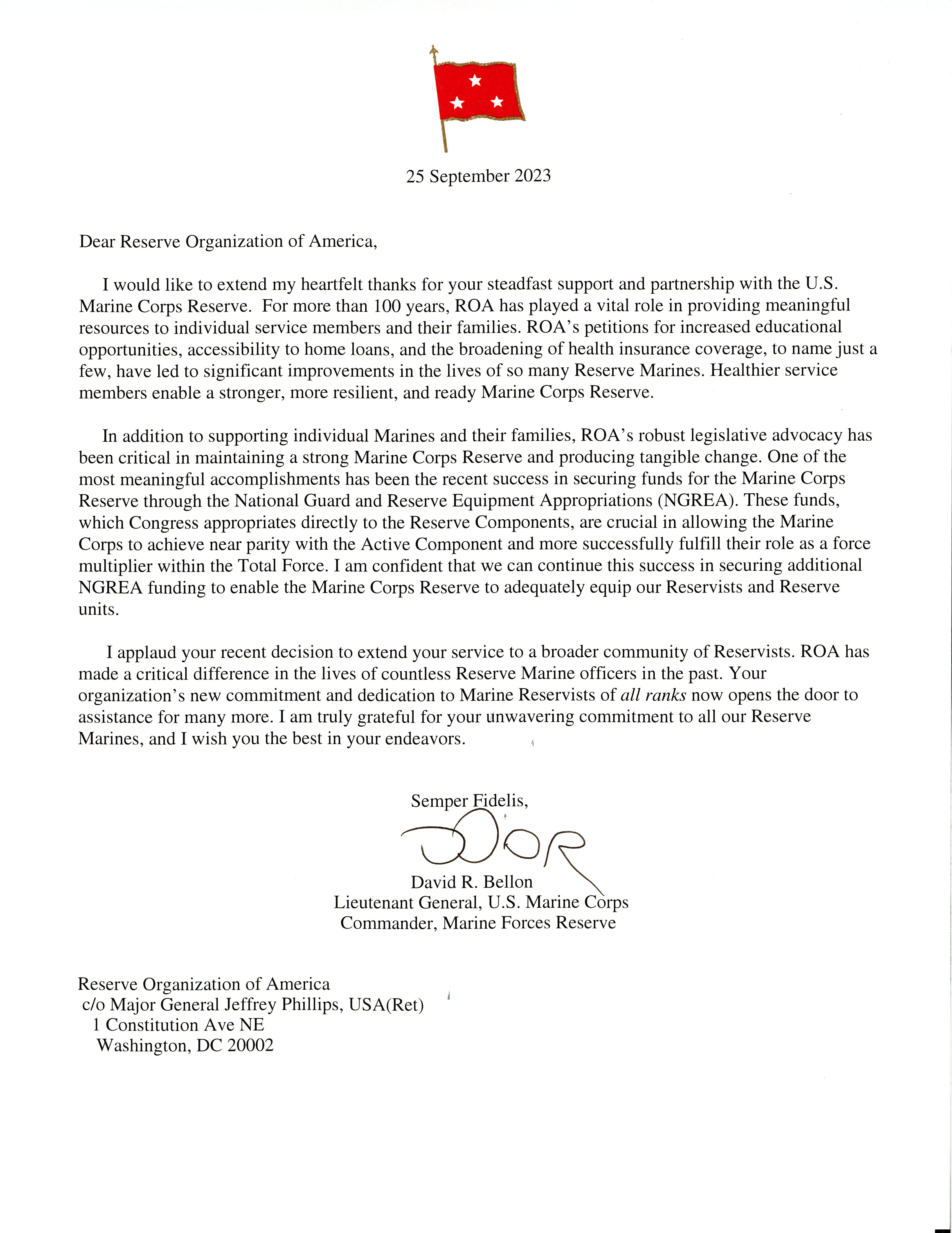
After his address to ROA’s national convention in Baton Rouge, Sept. 30, Sgt. Maj. Edwin A. Mota, Command Senior Enlisted Leader, U.S. Marine Corps Forces Reserve and U.S. Marine Corps Forces South, presented this letter from Lt. Gen. David G. Bellon, Commander, U.S. Marine Corps Forces Reserve and U.S. Marine Corps Forces South.
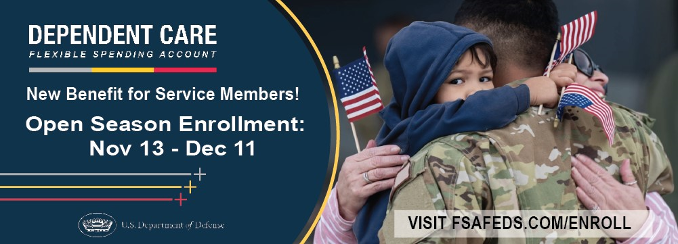
Open Season (Nov 13 – Dec 1) – New Benefit Alert! Dependent Care Flexible Spending Accounts (DCFSAs) for Service members and their families are now open for enrollment. Contribute up to $5,000 in pre-tax dollars to pay for eligible dependent care expenses. Visit https://www.fsafeds.com/explore/usmdcfsa to enroll today!
Open Season (Dec 4 – Dec 11) – Until December 11 at 11:59 pm ET, Service members can enroll in Dependent Care Flexible Spending Accounts (DCFSAs) and allocate up to $5,000 in tax free dollars to pay for eligible dependent care expenses. Visit https://www.fsafeds.com/explore/usmdcfsa to enroll today!
From Nov. 24 through Nov. 27, cardmembers receive:
0% interest and no payments for 90 days on purchases of $199 or more.
Double points on purchases. (Excludes Military Clothing Plan.)
On Black Friday, Nov. 24, cardmembers receive the following one-day-only savings:
15 cents off every gallon of gas at Exchange fuel locations.
15% off food purchases at participating Exchange restaurants.
$10 off a purchase of $25 or more at Exchange mall vendors (coupon required).
Cardmembers can also save an extra 15% on clothing, shoes, handbags, jewelry and watches, including clearance items, from Nov. 23 through Nov. 27. New cardmembers save an additional 10% on all purchases made the first day.
“Using your MILITARY STAR to shop the already-great Black Friday through Cyber Monday deals is an easy way to get even more value for your money,” said Air Force Chief Master Sgt. Kevin Osby, the Army & Air Force Exchange Service’s senior enlisted advisor. “You can go all-out on your holiday shopping without breaking your budget.”
Using MILITARY STAR automatically enters cardmembers into two holiday sweepstakes. Any time MILITARY STAR is used at an Exchange restaurant through Nov. 30, the cardmember has a chance to win a $1,000 Exchange gift card. All swipes through Dec. 31 earn an entry into the Your Holiday Bill Is on Us sweepstakes, with a chance to win statement credits ranging from $500 to the entire card balance.
The MILITARY STAR card is an exclusive line of credit for service members and their families to use at exchanges and commissaries – no matter where they serve. For more information, visit https://aafes.media/MilStarPA.
Social-media-friendly version: MILITARY STAR cardmembers
can gobble up deals and discounts Black Friday through Cyber Monday, all while earning double points! From Nov. 24 through Nov. 27, receive 0% interest and no payments for 90 days on purchases of $199 or more. On Nov. 24 only, save 15 cents per gallon
on fuel, 15% on food and $10 on a $25 purchase from mall vendors. Savings details: https://wp.me/p9Q7PG-2yS.
Posted By Executive Director Maj. Gen. Jeff Phillips, U.S. Army Retired,
Saturday, November 11, 2023
We say, Thank you
To all the men and women who are serving and who served in the uniformed services of our nation to protect our great nation, we say, Thank you.
Whether standing watch in the dead hours of the night on a cold and empty perimeter or standing watch on the bridge wing of an American warship in dangerous waters; for your vigilance, you have our Thank you.
When our nation needed you for operations and contingencies and wars around the globe, humanitarian assistance and disaster relief – home and abroad – you stood and answered the call: We say, Thank you.
When you shared those special moments: being recognized for your accomplishments, the laughter you had with comrades, and the grief for a fallen comrade . . . for your being one of our military family, we say, Thank you.
When you sacrificed – time away from family, your sons and daughters, your husband, your wife, your civilian career – to serve and defend the Constitution; for that sacrifice, we say, Thank you.
Happy Veterans Day, Citizen-Warrior – happy because you secure and have secured our liberties so that we may live free men and women. May God continue to bless you, our veterans; and while those blessings flow, we say, Thank you.
Posted By Past National President Col. Judi Davenport, retired,
Tuesday, October 24, 2023
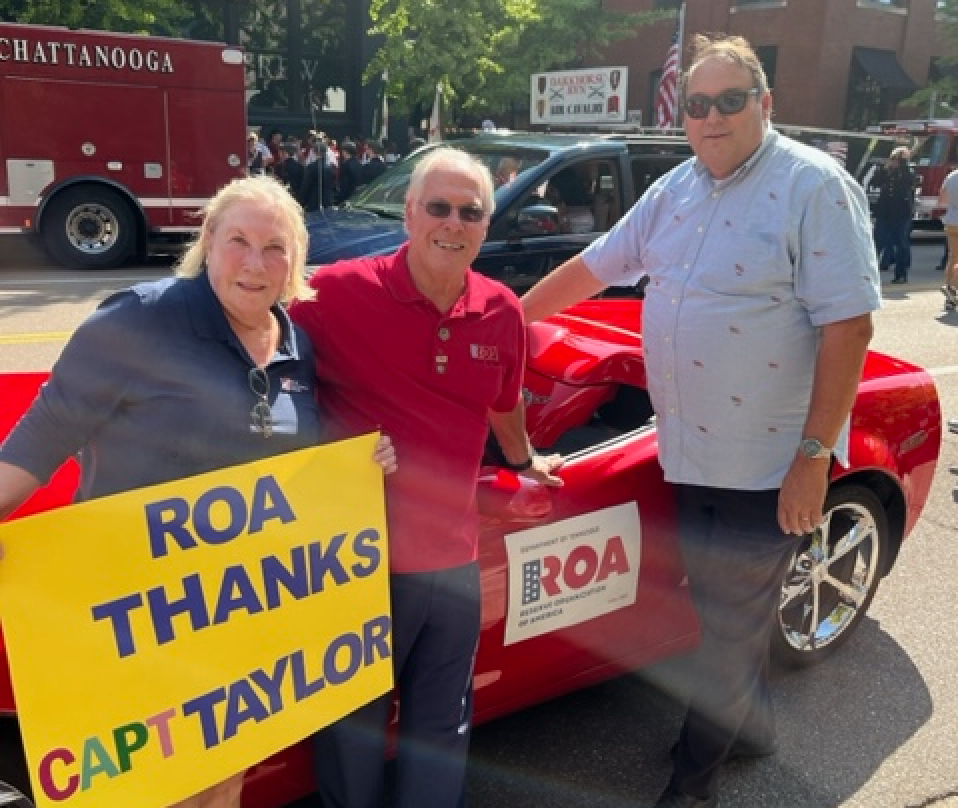
ROA’s Tennessee-Chattanooga Chapter honored Medal of Honor Society inductee Capt. Larry Taylor, U.S. Army Reserve and his wife Toni during a parade on Sept. 11, 2023.
Posted By Dir. of Operations Tremayne Criner,
Tuesday, October 24, 2023
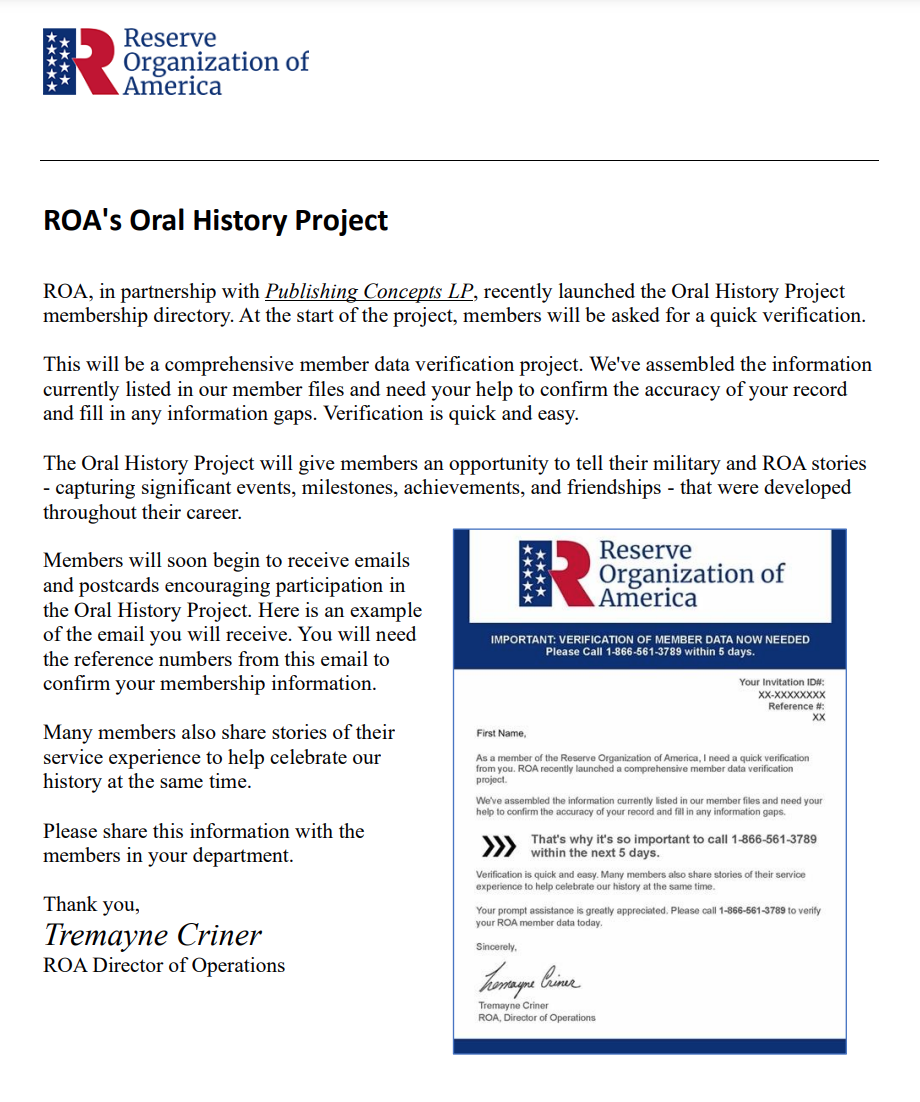
ROA, in partnership with Publishing Concepts LP, recently launched the Oral History Project.
The Oral History Project will give members an opportunity to tell their military and ROA stories - capturing significant events, milestones, achievements, and friendships - that were developed throughout their career.
If you have received the postcard or email, don't hesitate to respond to verify your membership information and record your story.
Posted By Dept. of Veterans Affairs,
Monday, October 23, 2023
The PACT Act is a new law that expands VA health care and benefits for Veterans exposed to burn pits, Agent Orange, and other toxic substances.
The PACT Act adds to the list of health conditions that we assume (or "presume") are caused by exposure to these substances. This law helps us provide generations of Veterans—and their survivors — with the care and benefits they've earned and deserve.
VA publishes the PACT Act Performance Dashboard every other Friday to measure the implementation of this legislation and showcase its impact on Veterans and survivors. As part of VA’s commitment to transparency, we are sharing the same dashboard both internally and externally to maximize accountability to the Veterans, families, caregivers, and survivors we serve.
VA will not rest until every Veteran gets the toxic exposure-related care and benefits they deserve. To apply today or learn more about what the PACT Act could mean for you, visit VA.GOV/PACT or call 1-800-MYVA411.
 Blog Home
 All Blogs

 RSS
RSS