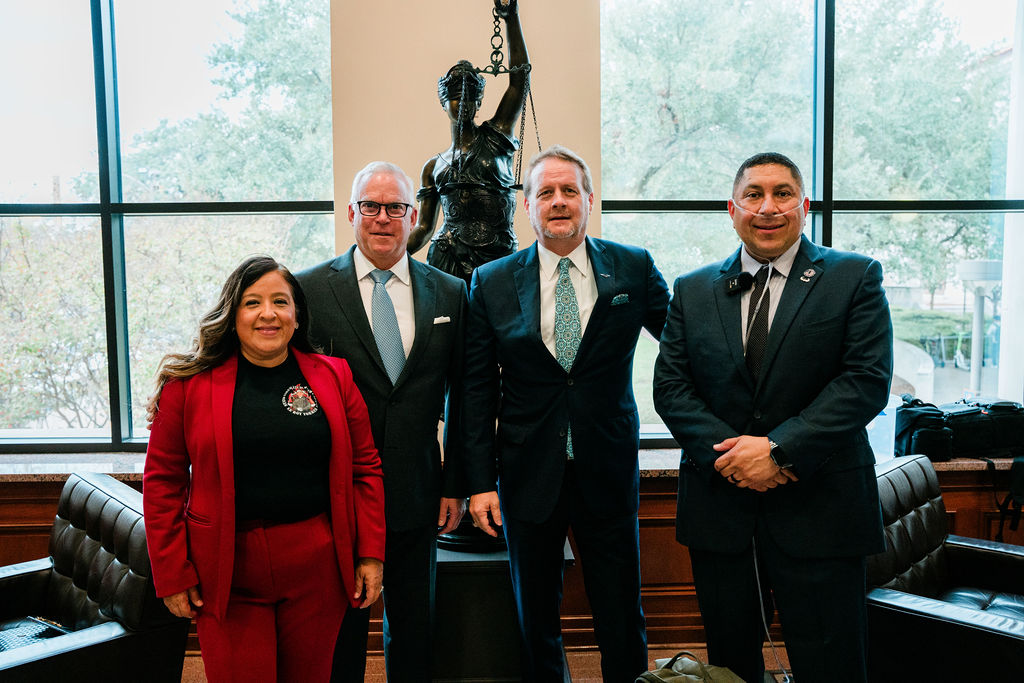
From left to right: Burn Pits 360 Co-Founder Rosie Torres; Brian Lawlor of Pilot Law P.C.; Stephen Chapman of Webb, Cason & Manning; and Burn Pits 360 Co-Founder Capt. Le Roy Torres, retired U.S. Army Reserve, pause for a photo after arguments before the Texas 15th District Court of Appeals on Nov. 20, 2025.
The Texas Fifteenth Court of Appeals recently heard oral arguments in a landmark veterans' rights case that could reshape how Texas courts interpret employment protections for servicemembers with service-connected disabilities. The November 20, 2025 hearing at the University of Texas Law School showcased the complex legal questions surrounding Texas Department of Public Safety v. Leroy Torres (Case No. 15-24089), a case with far-reaching implications for veterans across the state, and country.
Capt. Leroy Torres, an Army Reserve officer who served in Iraq, won a stunning $2.49 million jury verdict against the Texas Department of Public Safety (DPS) for violations of the Uniformed Services Employment and Reemployment Rights Act (USERRA). This represents the first time a USERRA case has ever been brought to trial verdict in the state of Texas.
The Background: From Burn Pits to Legal Victory
Torres's story exemplifies the challenges faced by thousands of veterans exposed to toxic burn pits during overseas deployments. As documented in the PACT Act materials, "over 3.5 million service members have been exposed to these burn pits while serving overseas," with exposure leading to serious long-term health effects including "types of cancers, asthma, COPD, rhinitis, and more."
Torres was deployed to Iraq in 2007, where he was exposed to toxic burn pits - large areas where the military incinerates waste including "plastics, rubber, chemicals, petroleum products, munitions, medical and human waste." Upon returning, he developed constrictive bronchitis, a respiratory condition that made it impossible for him to continue his duties as a state trooper.
The case made legal history when it reached the U.S. Supreme Court in Torres v. Texas Department of Public Safety (2022). As noted in the legal analysis, "On 6/29/2022, the United States Supreme Court decided this extraordinarily important case and determined that Texas and the other 49 states cannot invoke sovereign immunity to prevent lawsuits in State courts against State agencies, as employers, for violating USERRA."
The Appeal: Technical Arguments Over Veteran Protection
During oral arguments, DPS attorney Jason Contreras argued that the case was tried under the wrong legal theory. "It is undisputed that when trooper Leroy Torres returned from military service, he was re-employed by DPS to the same full duty trooper position he previously held. Therefore, section 4313 of USERRA, the reemployment section of USERRA does not apply," Contreras contended.
The state's position centered on a technical distinction between USERRA sections 4313 (reemployment protections) and 4311 (anti-discrimination protections). Contreras argued that "4313 is the section that protects a military member up to the instant of reemployment. Once that reemployment is triggered... that's when the protections under 4311 kick in."
However, Torres's attorney Brian Lawler, a retired Marine Corps Lieutenant Colonel and life member of the Reserve Organization of America (ROA), pushed back forcefully. "This is an important groundbreaking case," Lawler told the court. "As Justice Field pointed out, it's also a case of first impression. There isn't another case like this out there."
The Federal Regulation Debate
A key point of contention involved Department of Labor regulations that suggest USERRA's reemployment protections might continue after initial reemployment if a disability isn't discovered until later. When Justice Field asked about federal regulations Torres cited, Contreras dismissed them: "They are misrepresenting that code of federal regulation and there is no case in any circuit that has held that that is controlling authority."
Lawler countered by emphasizing the unique nature of latent military injuries: "There are tens of thousands of service members who have come back in the 20 odd years with latent injuries like Captain Torres... It's going to keep happening. So is it worth the wait and the X chance possibility that Congress does this?"
More information:
 Blog Home
 All Blogs

 RSS
RSS