|
|
Posted By AAFES Public Affairs,
Saturday, January 24, 2026
|
As military families set wellness goals for the new year, the Army & Air Force Exchange Service is supporting healthier lifestyles through a broad network of convenient wellness services at installations worldwide. The Exchange provides convenient medical and wellness services at approximately 300 locations worldwide, offering care where military communities live and serve. Each year, approximately 1.3 million patients are seen across Exchange optical and optometry centers, dental offices, chiropractic clinics and other wellness locations. These services help families, retirees and DoW and Coast Guard civilians access everyday care close to home, reducing the need to travel off installation for routine appointments. “The Exchange is committed to supporting the wellness of our military communities,” said Air Force Chief Master Sgt. Rich Martinez, the Exchange’s senior enlisted advisor. “By offering convenient access to essential wellness services on installations worldwide, we help reduce barriers to care and support quality of life.” Exchange wellness offerings vary by location and may include:
- Optical and optometry services
- Dental offices
- Nutrition and wellness centers
- Medical equipment and additional supplemental services
In the fall of 2026, the Exchange will open mental health clinics at Camp Foster in Okinawa and U.S. Army Garrison Humphreys in South Korea. Additional clinics will follow at Kadena Air Base in Okinawa, Yokota Air Base in Japan and Osan Air Base in South Korea. Shoppers can explore available wellness services by installation through the Exchange’s Wellness Hub at https://publicaffairs-sme.com/Community/wellness. In addition to wellness services, Exchange stores and ShopMyExchange.com offer gear and products that support healthy living, including activewear, athletic footwear, fitness accessories and wellness essentials from national brands.
This post has not been tagged.
Permalink
| Comments (0)
|
|
|
Posted By ROA Staff,
Saturday, January 24, 2026
|

ROA National President Peggy Wilmoth seeks applicants for appointment to the position of National Treasurer. This is a volunteer position for any member of ROA; length of position is two (2) years.
ROA’s Bylaws outline the role of the Treasurer:
The treasurer shall be the chief financial advisor to the president and advise the Board of Directors and president on fiscal policies and management of the financial affairs of the Association; recommend budgetary and fiscal controls and fiscal report formats to the Board of Directors; monitor financial operations of the Association; conduct, at a minimum, an annual meeting with the chairs of the Board of Trustees, Budget and Finance Committee, Insurance and Financial Services Committee, Resource Development Committee, and any other permanent or ad hoc financially-related committees; and perform such other advisory functions as are incident to the office.
Expectations/Requirements of the National Treasurer
- Willing and able to advise the National President on all matters concerning ROA’s budget and investments;
- Formal accounting background is essential;
- Background in managing a diverse portfolio;
- Understanding of tax law helpful;
- Ability to work with others and clearly communicate details about finances and budgets;
- Experience in working with non-profits is desirable;
- Able to attend quarterly Board Meetings in Washington, D.C.
Process:
Interested ROA members should submit a letter of interest that outlines their experience in relationship to the position requirements to the National President (pwilmoth@roa.org) no later than February 1, 2026. She will then schedule interviews with applicants. Notification of her decision will be by phone call and formal letter no later than March 1, 2026.
This post has not been tagged.
Permalink
| Comments (0)
|
|
|
Posted By ROA Executive Director John B. Hashem, Major General, USA (Ret) ,
Saturday, January 24, 2026
|
This year marks the 250th anniversary of our nation’s founding. This anniversary is not simply a ceremony. It is a reckoning. Citizens defended the United States at its birth. They set aside their tools and trades, left their families, and answered the call without standing armies or guaranteed support. The citizen-soldier was not a slogan. Citizens formed the force. ROA’s America’s 250 theme, The Citizen-Soldier: Then. Now. Tomorrow., claims that legacy and applies it deliberately across everything ROA does to execute Vision 29. ROA does not treat America’s 250 as a one-time program or commemorative campaign. ROA uses it as a unifying construct to drive advocacy, education, partnerships, and national convening through 2026, and to shape how the nation prepares the Reserve Components for the future. Then America has never relied on a large standing force to meet every crisis. America has relied on citizens who train part-time, mobilize when required, and return to civilian life when missions end. That model built the nation and sustained it through war, disaster, and domestic emergency. When the system works, it delivers decisive results. When leaders neglect it, failure follows quickly. In 1814, militia forces collapsed at Bladensburg, not because they lacked courage, but because leaders failed to resource, integrate, and prepare them. That failure opened the road to Washington and led directly to the burning of the Capitol. The lesson endures. A nation that depends on citizen-soldiers must treat the Reserve Components as a core military capability, fully integrated and fully supported. Obligation runs both ways. Now An enduring operational Reserve. Today’s Reserve Components operate globally, integrate across all domains, and support daily missions. Their value extends beyond operational performance alone. Simultaneous strategic depth. Modern conflict, large-scale combat operations, unfold over time. These wars demand endurance. The nation must rotate forces, regenerate capability, sustain logistics, and remain committed for years, not months. Reserve Components provide that endurance. They provide and must be prepared for strategic depth. At the same time, the homeland is no longer a sanctuary. Adversaries will actively target force flow, logistics networks, critical infrastructure, cyber systems, and public confidence. The Reserve Components stand at the center. They defend the homeland while enabling sustained power projection forward. Operational relevance and strategic depth exist together or not at all. Tomorrow Vision 29 demands ROA assist in preparing the uniformed Reserve for sustained conflict alongside a contested homeland. America’s 250 provides ROA clarity to make that case without apology. ROA’s advocacy, duty status reform, pay and benefit continuity, predictable health coverage, family readiness, and force-design recognition, does not seek new privileges. These reforms complete unfinished obligations embedded in the citizen-soldier model itself. ROA champions the Reserve, empowers the member, strengthens the institution, and secures the future because national security demands it. How ROA Will Honor America’s 250 Under The Citizen-Soldier: Then. Now. Tomorrow., ROA will integrate America’s 250 thematically and operationally across its activities through 2026. ROA will frame legislative advocacy as founding-era continuity, not modern exception. ROA will tie advocacy and support directly to sustaining an operational Reserve that delivers strategic depth and homeland defense during protracted conflict. ROA will shape education and programming around the citizen-soldier narrative across generations. ROA will link the militia, the National Guard, and the Reserves to modern force design and national resilience through digital content, publications, and national forums. ROA will align partnerships around America’s 250 as a national moment, supporting education, readiness, advocacy, and recognition of the Reserve Components as foundational to national defense. October 2026: The Culmination ROA’s October 2026 Annual Meeting will serve as the capstone of this national effort. ROA will honor America’s 250 and recognize the Reserve Components as the modern embodiment of the citizen-soldier. ROA will gather not only to reflect on 250 years of service, but to define the path forward. This will not be a retrospective celebration. ROA will deliver a forward-looking affirmation that the Reserve Components have been, remain, and will increasingly become essential to America’s national security. Citizens secured America’s independence through sustained service, not momentary effort. America’s future depends on whether the nation equips, sustains, and honors that same model. Through The Citizen-Soldier: Then. Now. Tomorrow., ROA will ensure America’s 250 is not simply remembered, rather, fulfilled.
This post has not been tagged.
Permalink
| Comments (0)
|
|
|
Posted By Taylor Deacon for Rep. Gil Cisneros,
Thursday, January 8, 2026
|
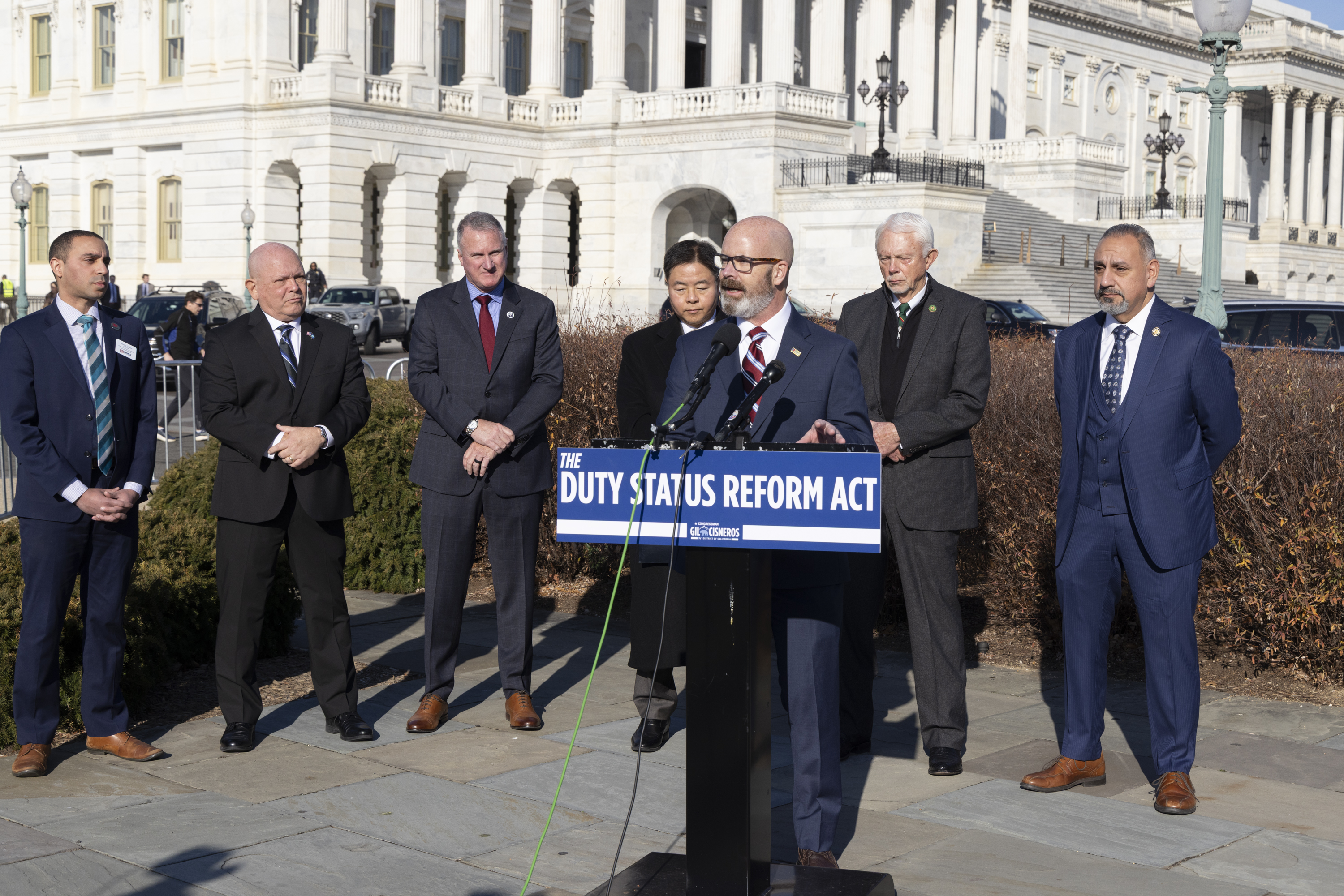
Washington, D.C. – Today, Reps. Gil Cisneros (CA-31) and Jack Bergman (MI-01) introduced the bipartisan Duty Status Reform Act which would reduce the Reserve Component’s (RC’s) duty statuses from roughly 30 to four. This change would create a coherent structure, ensuring our servicemembers receive equitable benefits and pay when called to service. The bill is cosponsored by Vice Chair of the Democratic Caucus Ted Lieu (CA-36) and Congressman Sam Graves (MO-6). The bill is endorsed by the National Guard Association of the United States (NGAUS), Reserve Organization of America (ROA), Enlisted Association of the National Guard of the United States (EANGUS), and Military Officers Association of America (MOAA). With today’s overly complex, burdensome duty status system, servicemembers doing similar jobs often receive different benefits due to the sheer number of duty statuses. This construct has created major disparities for troop pay and benefits like TRICARE and the Post-9/11 GI Bill. Under the new duty statuses established in this bill, servicemembers carrying out assignments within the same category will receive the same pay and benefits package.
“Efforts to simplify the complex duty status system began over two decades ago. We owe it to our servicemembers to deliver this much-needed change and ensure they are receiving equitable pay and benefits,” said Rep. Gil Cisneros. “This was my number one priority returning to Congress. Having worked on this issue during my time at the Pentagon, I learned about the complexity of the current duty status system and how it hurts our readiness and quality of life for servicemembers. I am proud to introduce this bipartisan legislation with Rep. Bergman, who knows firsthand the issues with the current structure, and I look forward to working with the Administration and my colleagues in Congress on this critical reform.”
“The Duty Status Reform Act is a commonsense win for our Reserve and National Guard servicemembers,” said Rep. Jack Bergman. “It cuts through decades of red tape to make sure those who serve get consistent benefits, clear orders, and the support they’ve earned - whether they’re responding to disasters at home or missions abroad. I’m proud to support this modernization effort to strengthen readiness and reduce bureaucracy.”
“Duty Status Reform is a long overdue step forward for our force and the nation. The National Guard has protected the homeland for nearly four centuries. As our tempo of operations has increased, it requires increased accessibility and flexibility,” said Major General (retired) Francis McGinn, president of NGAUS. “This legislation streamlines an overly complex system of over 30 duty statuses into four categories, cleans up nearly 300 laws, saves taxpayer dollars, and requires no additional scoring. We are grateful to Congressmen Cisneros and Bergman for leading this charge and we look forward to working with Congress to accomplish this much needed reform.”
“This is a great step forward for the eight hundred thousand plus men and women of the Reserve Components,” Command Sergeant Major (retired) John D. Gipe, Executive Director of EANGUS “Duty Status Reform has been a topic of discussion and studies for over fifteen years. Finally, with the help of Representatives Cisneros and Bergman, this important modernization of the laws that support our Servicemembers and their Families is moving forward. Our Warriors will finally get the benefits they deserve for performing their service in uniform. The Soldiers and Airmen of the National Guard, along with their Reserve counterparts, are grateful to all who have had a hand in bringing this issue to the forefront.”
“Duty Status Reform replaces a burdensome maze of statutory authorities governing reserve service with a clear, predictable framework, allowing the military to operate faster and directly tying service to defined pay and benefit entitlements,” said Major General (retired) John Hashem, CEO of ROA. “It ensures uniform benefit accrual, reduces record disputes, and delivers equal DoD/W and VA benefits for identical service.”
"This legislation addressing Duty Status Reform simplifies the Pentagon's access to the Reserve Forces helping maintain mission readiness and enhancing force posture,” said Jimmy Santos, Director of MOAA. “For servicemembers in the Reserve, it guarantees equal delivery of benefits to include healthcare and the housing allowance."
Rep. Cisneros is a Navy Veteran and the former Under Secretary of Defense for Personnel and Readiness. He currently serves on the House Armed Services Committee, Subcommittee on Military Personnel, and Subcommittee on Intelligence and Special Operations. Rep. Cisneros is a member of the Congressional Hispanic Caucus and serves on its leadership team as the Freshman Representative.
This post has not been tagged.
Permalink
| Comments (0)
|
|
|
Posted By ROA Staff,
Saturday, December 20, 2025
|
From the President’s Budget to conference—and how ROA turned advocacy into wins for the Reserve Component Every NDAA story begins with the president’s budget submission to Congress. That blueprint does more than set toplines. It frames priorities, timelines and trade-offs, and it serves as the foundation for Armed Services subcommittee marks in both chambers.
Committees test assumptions against requirements, translate strategy into bill text, and lay down the first red lines that steer the debate. From there, subcommittees mark their sections, full committees amend and adopt, and the House and Senate pass their versions to set up a conference.
This year, final negotiations unfolded amid — and during — the longest government shutdown in U.S. history, a grinding backdrop that added complexity to scheduling, staffing and floor choreography. And because last year’s NDAA delivered historic quality-of-life reforms via the House Quality of Life Panel — including full coverage of costs associated with drill weekends — many expected FY 2026 to be more modest and less dramatic.
That said, the drama still arrived, only in different places. ROA stepped into that arena with a clear aim: make sure reserve equities are visible in the text, defensible in the math, and executable on the ramp.
Modernization with purpose: HMMWVs, C-130s and KC-46s
Army Tactical Wheeled Vehicles (Section 111). ROA pressed for modernization parity for the Army Reserve’s aging tactical wheeled vehicle fleet, partnering with AM General for the second consecutive NDAA to secure funding pathways and keep HMMWV recapitalization at the forefront of the debate. The final bill extends the Army Tactical Wheeled Vehicle strategy through FY 2027, giving the Army, Congress and ROA an authorization bridge to address safety, maintenance and mission readiness for the Reserve.
C-130 inventory and modernization (Section 145). Airlift is how the Reserve carries America’s logistics on ordinary days and surges in extraordinary ones. ROA rebuilt ties with the Navy Reserve legislative office and collaborated extensively on C-130 modernization, recognizing contested logistics as a joint fight. On Capitol Hill, ROA worked closely with Rep. Barry Loudermilk’s office, culminating in recognition of Eric Johnson, the congressman’s senior defense and policy adviser, with ROA’s Excellence in Legislative Readiness Award for his role advancing recapitalization priorities. In law, Section 145 extends the minimum C-130 inventory through FY 2026 and adds a modernization report, keeping the fleet steady while recapitalization plans mature.
Tanker protection, KC-46 accountability, and seeing more at Seymour (Sections 141 and 164). Aerial refueling is the connective tissue of U.S. global operations, and reserve units shoulder a major share. ROA supported raising the tanker fleet minimum and protecting KC-135 primary mission aircraft inventory during KC-46 recapitalization, so reserve squadrons are not hollowed out mid-transition. At the same time, Section 164 ties additional KC-46 deliveries to credible corrective action on Category 1 deficiencies, marrying modernization with accountability.
Those priorities were not shaped from afar. They were informed on the ramp. During an ROA tour of Seymour Johnson Air Force Base, ROA had exclusive access to see the KC-46 up close, speak with aircrews and maintainers, and hear directly how the Pegasus’ strengths and pain points play out under day-to-day operations. That firsthand experience sharpened ROA’s modernization recommendations for the Air Force Reserve, particularly around reliability, training and mission planning.
Fighters in transition: F-15s and A-10s, with continuity as the watchword
F-15E retirements and the path to EX II (Section 142). The FY 2026 NDAA holds the line on no F-15E retirements in FY 2026, then allows phased reductions thereafter — an authorization choice that protects training pipelines and Total Force fighter experience while recapitalization plans, including EX II fielding, come into focus.
ROA’s support for the F-15 platform, particularly the EX II, was identified in a high-level meeting with Chief of the Air Force Reserve Lt. Gen. John Healy, ROA Air Force Service Section Vice President Susan Lukas, and ROA Director of Legislation and Military Policy Matthew Schwartzman.
Following that, Schwartzman and the Air Force legislative liaison office worked hand in hand on areas of mutual interest, including sufficient F-15 fielding to sustain reserve training, surge capacity and deterrence.
A-10 inventory and Whiteman Air Force Base (Section 147). Congress set an A-10 primary mission aircraft inventory floor and authorized limited retirements — guardrails to prevent premature divestment while transition plans are written. ROA’s approach here was deliberately local and operational, including direct collaboration with 442nd Fighter Wing leadership, coordinated closely with Lukas, ROA Department of Missouri President Don Stockton, and Sen. Eric Schmitt’s office to shape the inventory language and protect Whiteman’s mission continuity. Going forward, ROA’s focus is singular: help the 442nd secure the appropriations it needs so the victory written into authorization is realized on the flight line.
End strength and MEDEVAC: A fight for lives and strategic depth
Section 411 sets the numbers — and those numbers tell a story. The NDAA grows end strength for the Army National Guard, Marine Corps Reserve, Air Force Reserve and significantly for the Coast Guard Reserve, while reducing the Army Reserve by 3,800 and the Air National Guard by 1,400.
For ROA, these reductions are not abstract. They hit hardest in Army Reserve aviation and MEDEVAC, the lifeline capability that has driven battlefield survival to historic highs.
At ROA’s annual conference, this risk took center stage during a defining panel, “Current and Future Planning for Helicopters and Aeromedical Casualty Evacuation During Large-Scale Land Combat Operations.” The discussion confronted the Army’s plan to eliminate all Army Reserve rotary-wing aviation units by October 2026.
The panel was moderated by ROA Executive Director, retired Army Reserve Maj. Gen. John Hashem, and joined by senior aviation and aeromedical experts who examined how the Army’s transformation risks erasing critical strategic depth in combat casualty evacuation, homeland response and sustainment operations. While modernization and unmanned systems promise new capabilities, panelists agreed eliminating Reserve aviation would create gaps that could take years to rebuild, weakening both national and domestic response capacity.
In direct response, ROA delegates voted unanimously to adopt a resolution supporting Sen. Ted Cruz’s RESCUE Act, a measure designed to preserve joint force aeromedical evacuation capability.
The resolution commits ROA to championing MEDEVAC and related aviation functions within the Reserve Component, ensuring highly skilled aviators, medics and maintainers remain integral to the Total Force.
Readiness for the fights we don’t get to choose
Munitions and two-war planning (Sections 361–364). The NDAA’s tighter reporting on minimum munitions production, industrial surge capacity and two-war readiness is more than paperwork. It is how Congress forces the system to confront real requirements and timelines.
ROA credits former intern Peter Donlon, whose draft publication, Bombs Over Beijing: A Look at the Reserve Components in Large-Scale Combat Operations, helped quantify the gap between current stockpiles and real-world consumption rates, sharpened the case for allied demand planning, and underscored the Reserve’s role in sustained operations.
Indo-Pacific mobilization (Section 383). Modeled on the historic “Nifty Nugget” mobilization stress test, Section 383 directs a comprehensive Indo-Pacific mobilization readiness study, including Reserve integration and a civilian skills inventory, to ensure planning reflects the Total Force. ROA’s engagement began when retired Army Sgt. Maj. Minyard identified the large-scale mobilization challenge and the relevance of Nifty Nugget at a Reserve Forces Policy Board summit, later reinforced by insights from the Honorable Robert Keohane, former assistant secretary of defense for manpower and readiness, at last year’s annual meeting.
People first: TAP and AvIP parity
Transition Assistance Program (Section 571). TAP is where readiness meets real life — jobs, families and the transitions reservists navigate more than once. ROA testified before Congress twice on reforms incorporated into the FY 2026 NDAA, particularly the authority allowing Reserve Component members to waive their TAP requirement under scoped conditions.
This marks the second consecutive year ROA secured a portion of its five-point TAP improvement plan in the NDAA, working closely with Chairman Van Orden, who also partnered with ROA on landmark USERRA reform and received ROA’s Excellence in Legislative Readiness Award.
Aviation Incentive Pay (Section 613). AvIP parity has been years in the making, dating back to 2022. ROA life member and former legislative director Susan Lukas began the effort with TMC President Jack Du Teil, achieving early progress in the FY 2022 NDAA. When implementation stalled due to cost concerns, Du Teil raised the issue with Secretary Pete Hegseth at a roundtable attended by ROA Director of Programs and Events Trey Criner. In the final hours of this year’s conference, ROA spearheaded a coalition letter supported by more than 24 organizations, pushing the Senate-only provision into the conference report. Section 613 now requires the Defense Department to evaluate AvIP and establish a standardized framework on an accelerated timeline.
The road ahead: Turning policy into readiness
The NDAA is more than a bill. It is a promise. ROA’s work now shifts from authorization to implementation, focusing on appropriations, oversight and execution.
ROA will continue pressing for KC-46 fixes before fielding, tanker inventory protections, C-130 recapitalization, AvIP parity implementation, mobilization readiness and parity reforms across the Reserve Component.
The FY 2026 NDAA affirms what ROA has long maintained: The Reserve Component is indispensable to America’s defense. Advocacy helped shape this year’s wins, but the measure of success will be seen in aircraft on the ramp, crews in the cockpit, medics in the cabin, and readiness in the fight.
This post has not been tagged.
Permalink
| Comments (0)
|
|
|
Posted By Matthew L. Schwartzman,
Friday, December 19, 2025
|
FOR IMMEDIATE RELEASE Washington, DC – December 19, 2025 — The Reserve Organization of America announced today that it is urging President Donald J. Trump to expand eligibility for the “Warrior Dividend.” In his December 17 address, the President said, “we are sending every soldier $1,776,” and that “the checks are already on the way,” describing a one‑time, tax‑free bonus to honor the nation’s founding and arrive before Christmas. Eligibility currently applies only to service members in pay grades E‑1 through O‑6 who are on active duty, and to Reserve and National Guard members in the same grades serving on continuous active‑duty orders of 31 days or more as of November 30. This leaves most of the nearly 800,000 operational Reserve and National Guard warriors excluded, despite their indispensable role in sustaining the Total Force. Dual-status technicians—who continued to serve and support missions during the recent government shutdown without receiving pay—are also not recognized or rewarded under this program. “Publicly promising universal reward for warriors and then excluding hundreds of thousands undermines credibility,” said retired Army Maj. Gen. John B. Hashem, Executive Director of ROA. “The citizen‑soldier secured America’s independence and is central to our celebration of the nation’s 250th anniversary. Citizen‑warriors have served in every war since, and they remain essential to the Total Force today. We urge the President to recognize this now—by ensuring parity for the operational Reserve and National Guard.” The $2.6 billion in funds for the Warrior Dividend were drawn from the One Big Beautiful Bill Act (Public Law 119‑21), which appropriated $2.9 billion originally intended to supplement the Basic Allowance for Housing (BAH). While the Administration’s decision to use these funds for a holiday bonus is welcomed, ROA believes that implementing the ‘Warrior Dividend’ without full Reserve Component parity creates inequitable outcomes, heightens retention risk, and erodes confidence in the coherence of personnel policy. As the nation approaches its 250th anniversary, it is imperative that we honor the citizen-warriors who secured America’s independence, have fought in every war since, and remain indispensable to the strength and readiness of today’s Total Force. If the Administration fails to act and correctthis inequity, ROA will turn its focus to Capitol Hill and urge Congress to fill the gap created by this void. For Contact:
Matthew Schwartzman
Director, Legislation and Military Policy
Reserve Organization of America
mschwartzman@roa.org

This post has not been tagged.
Permalink
| Comments (0)
|
|
|
Posted By ROA Staff,
Thursday, December 18, 2025
|

Dear ROA Members & Colleagues,
ROA extends its heartfelt gratitude to everyone who contributed to our 2025 Day of Giving fundraising drive. Your generosity and commitment to our mission mean so much to us. Although we did not reach the full $15,000 matching challenge offered by our anonymous donors, we are thrilled to share that we doubled last year’s total thanks to your support! As you consider your end-of-year giving, we hope you will include ROA on your list. Every gift—large or small—helps us continue the important work we do. Thank you again for standing with ROA! Respectfully, Dr. Peggy Wilmoth
Major General, USA (Ret.)
President, Reserve Organization of America
This post has not been tagged.
Permalink
| Comments (0)
|
|
|
Posted By ROA Staff,
Saturday, November 22, 2025
|
 Mark your calendar! Mark your calendar!
The ROA Army Section Town Hall is coming up at 7 p.m. (Eastern) on Wednesday, December 10, 2025, and you won’t want to miss it. Our featured speaker, MG Peggy Wilmoth, ROA’s National President, will share insights on Vision 29 — ROA’s strategic plan and what it means for our Army members. After her 30-minute presentation, there’ll be time for Q&A — your opportunity to speak directly with our National President and share your thoughts. A Zoom link will be emailed to Army section members as the date approaches. We’d love to see you there — your participation and perspective make ROA stronger. See you at the Town Hall! Respectfully,
Dr. Reece Newsome
ROA Vice President, Army
This post has not been tagged.
Permalink
| Comments (0)
|
|
|
Posted By ROA Staff,
Friday, November 21, 2025
|
 Every Reservist knows the feeling: serving twice as hard to get half the recognition. Too often, America’s Reserve Component is treated as an afterthought — in policy, in funding, and in national priorities. Every Reservist knows the feeling: serving twice as hard to get half the recognition. Too often, America’s Reserve Component is treated as an afterthought — in policy, in funding, and in national priorities.
That’s why ROA exists.
For more than a century, ROA has fought so our servicemembers never have to fight alone. And this year, your support helped fuel major advocacy wins — from protecting missions at risk to advancing reforms that strengthen readiness, benefits, and family stability for those who serve.
As we approach Giving Tuesday, I’m inviting you to stand with us again as we prepare for the next 12 months of legislative battles. Because the truth is simple:
Without ROA, America’s reservists have no unified voice in Washington.
With ROA, they have a seat at the table — and a defender they can trust.
Next week, you’ll hear more about how your donation directly drives results. Until then, thank you for being part of the only association dedicated solely to the Reserve Components.
Respectfully,
Dr. Peggy Wilmoth
Major General, USA (Ret.)
President, Reserve Organization of America
This post has not been tagged.
Permalink
| Comments (0)
|
|
|
Posted By ROA Staff,
Friday, November 21, 2025
|
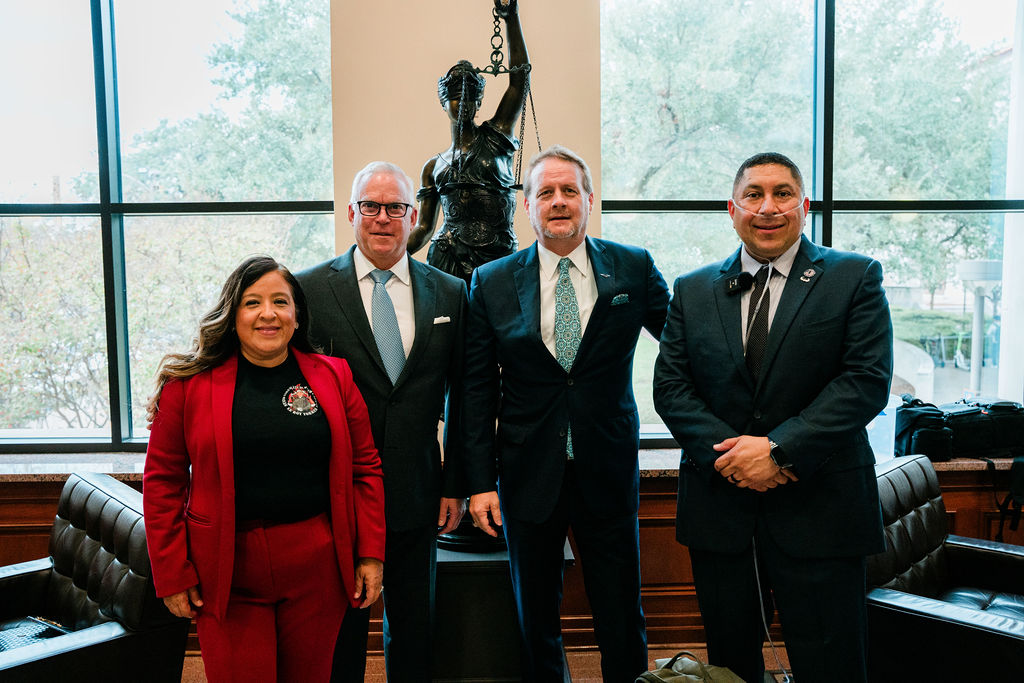
From left to right: Burn Pits 360 Co-Founder Rosie Torres; Brian Lawlor of Pilot Law P.C.; Stephen Chapman of Webb, Cason & Manning; and Burn Pits 360 Co-Founder Capt. Le Roy Torres, retired U.S. Army Reserve, pause for a photo after arguments before the Texas 15th District Court of Appeals on Nov. 20, 2025. The Texas Fifteenth Court of Appeals recently heard oral arguments in a landmark veterans' rights case that could reshape how Texas courts interpret employment protections for servicemembers with service-connected disabilities. The November 20, 2025 hearing at the University of Texas Law School showcased the complex legal questions surrounding Texas Department of Public Safety v. Leroy Torres (Case No. 15-24089), a case with far-reaching implications for veterans across the state, and country. Capt. Leroy Torres, an Army Reserve officer who served in Iraq, won a stunning $2.49 million jury verdict against the Texas Department of Public Safety (DPS) for violations of the Uniformed Services Employment and Reemployment Rights Act (USERRA). This represents the first time a USERRA case has ever been brought to trial verdict in the state of Texas.
The Background: From Burn Pits to Legal Victory
Torres's story exemplifies the challenges faced by thousands of veterans exposed to toxic burn pits during overseas deployments. As documented in the PACT Act materials, "over 3.5 million service members have been exposed to these burn pits while serving overseas," with exposure leading to serious long-term health effects including "types of cancers, asthma, COPD, rhinitis, and more."
Torres was deployed to Iraq in 2007, where he was exposed to toxic burn pits - large areas where the military incinerates waste including "plastics, rubber, chemicals, petroleum products, munitions, medical and human waste." Upon returning, he developed constrictive bronchitis, a respiratory condition that made it impossible for him to continue his duties as a state trooper.
The case made legal history when it reached the U.S. Supreme Court in Torres v. Texas Department of Public Safety (2022). As noted in the legal analysis, "On 6/29/2022, the United States Supreme Court decided this extraordinarily important case and determined that Texas and the other 49 states cannot invoke sovereign immunity to prevent lawsuits in State courts against State agencies, as employers, for violating USERRA."
The Appeal: Technical Arguments Over Veteran Protection
During oral arguments, DPS attorney Jason Contreras argued that the case was tried under the wrong legal theory. "It is undisputed that when trooper Leroy Torres returned from military service, he was re-employed by DPS to the same full duty trooper position he previously held. Therefore, section 4313 of USERRA, the reemployment section of USERRA does not apply," Contreras contended.
The state's position centered on a technical distinction between USERRA sections 4313 (reemployment protections) and 4311 (anti-discrimination protections). Contreras argued that "4313 is the section that protects a military member up to the instant of reemployment. Once that reemployment is triggered... that's when the protections under 4311 kick in."
However, Torres's attorney Brian Lawler, a retired Marine Corps Lieutenant Colonel and life member of the Reserve Organization of America (ROA), pushed back forcefully. "This is an important groundbreaking case," Lawler told the court. "As Justice Field pointed out, it's also a case of first impression. There isn't another case like this out there."
The Federal Regulation Debate
A key point of contention involved Department of Labor regulations that suggest USERRA's reemployment protections might continue after initial reemployment if a disability isn't discovered until later. When Justice Field asked about federal regulations Torres cited, Contreras dismissed them: "They are misrepresenting that code of federal regulation and there is no case in any circuit that has held that that is controlling authority."
Lawler countered by emphasizing the unique nature of latent military injuries: "There are tens of thousands of service members who have come back in the 20 odd years with latent injuries like Captain Torres... It's going to keep happening. So is it worth the wait and the X chance possibility that Congress does this?" More information:
This post has not been tagged.
Permalink
| Comments (0)
|
|
 Blog Home
 All Blogs

 RSS
RSS